If you’re apartment hunting in Miami, Brickell and Downtown usually land on the same shortlist, and for good reason. Both neighborhoods put you near the water, major employers, high-rise living, public transit, and some of the city’s best dining and entertainment. On a map, they look almost interchangeable. In real life, they do not feel the same.
That distinction matters when you’re choosing where to live. Brickell leans polished, residential, and finance-forward, with luxury towers, stylish restaurants, and a social scene that starts with happy hour and often keeps going. Downtown Miami feels broader and more mixed-use. It brings together office towers, museums, performance venues, waterfront parks, transit connections, historic corridors, and a faster-moving urban energy. If you want more Miami apartment-hunting context before narrowing your search, our guides on moving to Miami, the cost of living in Miami, and luxury apartments in Miami can help (Greater Miami Convention & Visitors Bureau 2025, Miami Downtown Development Authority 2026, AptAmigo 2025, AptAmigo 2026).
Should I Live in Brickell or Downtown Miami?
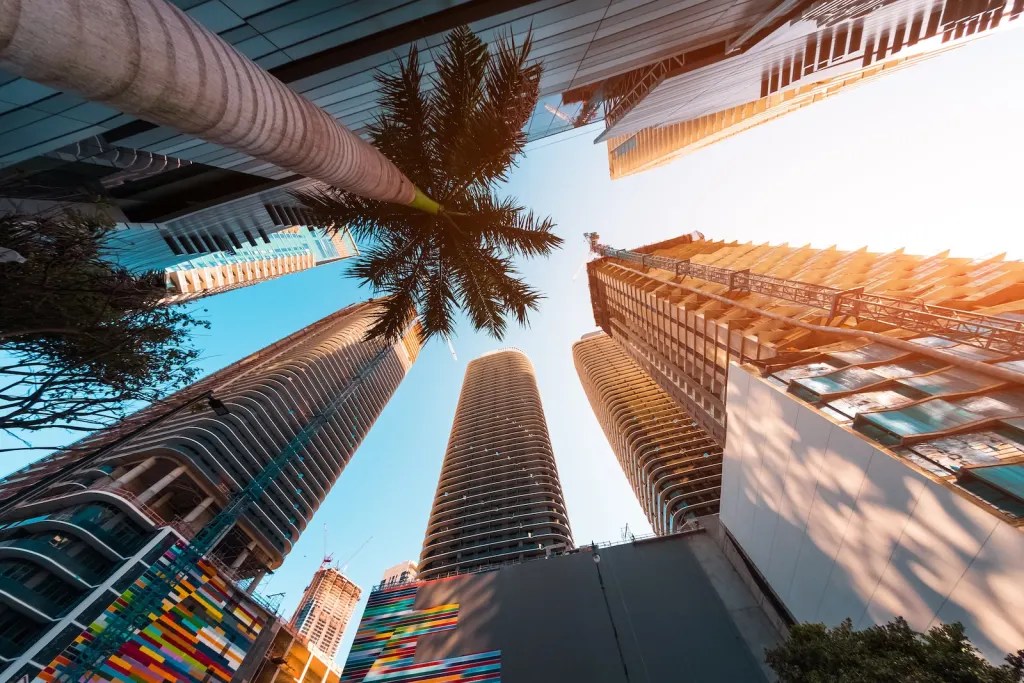


The best answer comes down to how you want your days and nights to feel.
Choose Brickell if you want a sleek, walkable neighborhood centered on upscale condo and apartment towers, polished amenities, business energy, and easy access to dining and nightlife. The neighborhood sits along Biscayne Bay and functions as Miami’s financial district, but it also packs in scenic parks, shopping destinations, and a strong after-hours culture. The official neighborhood guide highlights Brickell’s upscale restaurants, bars, attractions, and bayfront parks, which matches what renters tend to experience on the ground (Greater Miami Convention & Visitors Bureau 2025a).
Choose Downtown Miami if you want a denser, more civic, cultural, and transit-connected environment. Downtown offers direct access to places like Bayfront Park, Bayside Marketplace, the Pérez Art Museum Miami, the Phillip and Patricia Frost Museum of Science, and the Adrienne Arsht Center. It also benefits from the free Metromover system and a public-realm strategy that prioritizes walkability, waterfront connections, and better access to parks and transit (Miami Downtown Development Authority 2026a, Greater Miami Convention & Visitors Bureau 2025b, Bayfront Park Management Trust 2026, PAMM 2026, Frost Science 2026).
Neighborhood culture
Brickell feels like Miami’s dressed-up urban core. The skyline rises fast, the residential towers look glossy, and the crowd tends to include finance professionals, remote workers, luxury renters, and people who want to step outside into a neighborhood that already feels “on.” There’s a reason so many people describe Brickell as Manhattan-lite. Between Brickell City Centre, Mary Brickell Village, bay views, and a parade of rooftop and destination restaurants, Brickell often appeals to renters who want convenience with a social edge (Greater Miami Convention & Visitors Bureau 2025a, Simon 2026, Mary Brickell Village 2026).
Downtown Miami feels more layered. Yes, it has towers and business traffic, but it also has museums, concert venues, historic streets, government buildings, waterfront promenades, and a wider range of day-to-day activity. In one afternoon, you can pass commuters, tourists, students, office workers, and residents heading to the park or an exhibit. That variety gives Downtown more of a classic central-city feel than Brickell’s more curated luxury vibe. The Miami DDA explicitly positions the area around commerce, culture, tourism, and public-space connectivity, which helps explain why Downtown feels so multifaceted (Miami Downtown Development Authority 2026b).
Activities and lifestyle
For shopping, eating out, and meeting friends without much planning, Brickell has the edge. Brickell City Centre serves as a major neighborhood anchor for shopping, dining, entertainment, and culture, while Mary Brickell Village adds another cluster of restaurants and services in a walkable setting. Brickell also connects well to the waterfront and nearby green spaces, so it does not feel all concrete and glass (Simon 2026, Mary Brickell Village 2026, Greater Miami Convention & Visitors Bureau 2025a).
Downtown wins if your ideal weekend includes museums, performances, public events, or time by the bay. Bayfront Park spans 32 acres on Biscayne Bay, and nearby Maurice A. Ferré Park links directly to PAMM and Frost Science. The Adrienne Arsht Center adds a major performing arts draw, and Bayside Marketplace gives the neighborhood a tourist-friendly but still useful waterfront retail and dining hub. If you want more built-in cultural activity within walking distance, Downtown usually delivers more variety than Brickell (Bayfront Park Management Trust 2026a, Bayfront Park Management Trust 2026b, PAMM 2026, Frost Science 2026, Arsht Center 2026).
Noteworthy destinations
Brickell’s standout destinations tend to revolve around lifestyle and leisure. Brickell City Centre remains the neighborhood’s best-known retail anchor, and Mary Brickell Village still works as a reliable meeting point for dining and casual errands. The area’s appeal also comes from its waterfront setting and polished residential streetscape. If your dream neighborhood includes grabbing coffee downstairs, walking to dinner, and having upscale conveniences close by, Brickell checks that box very well (Simon 2026, Mary Brickell Village 2026, Greater Miami Convention & Visitors Bureau 2025a).
Downtown’s landmark list runs longer. Bayfront Park sits right on the bay, Bayside Marketplace adds shopping and sightseeing, PAMM and Frost Science anchor the museum district, and the Arsht Center gives the neighborhood a year-round performance calendar. Downtown also includes the historic Flagler corridor, where the city has continued public-realm improvements aimed at creating a stronger pedestrian experience (City of Miami 2026a, Bayside Marketplace 2026, PAMM 2026b, Frost Science 2026b, Arsht Center 2026b, City of Miami 2026b).
Places to eat
Brickell generally offers the stronger “let’s go out tonight” dining identity. The neighborhood’s official tourism guide emphasizes upscale restaurants and lively bars, and that reputation holds up. Places like Komodo fit the neighborhood perfectly: stylish, energetic, and built for a night out as much as a meal. Around Mary Brickell Village and Brickell City Centre, you’ll find the kind of polished dining mix that makes spontaneous weeknight plans easy (Greater Miami Convention & Visitors Bureau 2025a, Komodo Miami 2026, Simon 2026, Mary Brickell Village 2026).
Downtown’s dining scene feels more eclectic and less image-driven. That is not a knock; it is part of the charm. You can build a low-key outing around Julia & Henry’s, catch a show near the Arsht, or combine museum time with a waterfront meal. Downtown does not always project the same luxury-dining identity as Brickell, but it often offers more range in how you spend an evening. For renters who care more about variety and convenience than a polished scene, Downtown can feel more flexible (Greater Miami Convention & Visitors Bureau 2025b, Arsht Center 2026, Bayfront Park Management Trust 2026a).
History and sense of place
Brickell may look hyper-modern, but its roots run deep. The neighborhood is named after William and Mary Brickell, early Miami settlers whose trading post helped shape the city’s development, and the Miami Circle at 401 Brickell Avenue marks one of the most significant prehistoric archaeological discoveries in eastern North America. That history gives Brickell a stronger sense of continuity than many first-time renters expect from its glass-tower skyline (Greater Miami Convention & Visitors Bureau 2024, City of Miami 2026c).
Downtown Miami carries more visible layers of the city’s civic and architectural history. The area includes historic commercial corridors like Flagler Street, older landmark buildings, and a long-standing role as the center of business, transportation, and public life. Current planning documents still frame Downtown around its historic core while pushing for a more walkable and connected future. If you like neighborhoods that feel like they tell the story of a city, Downtown tends to feel richer in that way (Greater Miami Convention & Visitors Bureau 2025c, Miami Downtown Development Authority 2026c, City of Miami 2026b).
Transit and getting around
This category is close, because both neighborhoods benefit from strong central-city transit access. Downtown has the clearest advantage overall thanks to the free Metromover, which runs through the urban core and connects with Metrorail and Metrobus. The City of Miami trolley system also expands local mobility. For renters who want to rely less on a car, Downtown often feels easier day to day (Miami Downtown Development Authority 2026a, City of Miami 2026d).
Brickell still performs very well on convenience. You can reach transit, walk to essentials, and move around the neighborhood without constantly getting in your car. But Brickell’s daily experience often centers more on living within the neighborhood itself, while Downtown feels better set up as a larger hub connecting you to other parts of the city. That distinction matters if you commute frequently or want more flexibility for errands, events, and day trips (Miami Downtown Development Authority 2026a, Miami Downtown Development Authority 2026c).
Brickell or Downtown Miami: Which One Fits You Best?
Live in Brickell if you want your neighborhood to feel polished, social, and a little luxurious from the moment you step outside. It is a great fit for renters who value upscale dining, sleek high-rises, walkable convenience, and a finance-district energy that softens into nightlife after work.
Live in Downtown Miami if you want more range. Downtown suits renters who want culture, museums, performance venues, waterfront parks, transit access, and a neighborhood that feels like a true urban center instead of a single lifestyle lane. It can feel busier and less curated than Brickell, but that is exactly why many people love it.
If you want help comparing actual buildings in either neighborhood, AptAmigo can help you narrow the field based on commute, budget, view preferences, amenities, and lifestyle goals (Miami Downtown Development Authority 2026a).
FAQs
This article was AI-generated by AptAmigo.